Identifying metals in jewelry coins or antiques by cth
Author:cth
Language: eng
Format: mobi
Publisher: CTH
Published: 2009-10-05T04:00:00+00:00
Doing hardness test
You will need a few things first:
Lead fishing weight
Sterling silver such as a piece of jewelry
Aluminum can or aluminum foil
Piece of copper (penny made before 1982 or piece of copper tubing will work)
Iron file
These are common easily obtainable items you can use to test the hardness of a metal. You can obtain these and cut or shape them into a point for testing.
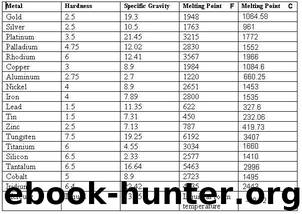
By looking at the hardness column in the chart below you can use the scratch test to narrow down the metal type. Metals in this column will only scratch metals listed below it. Aluminum would scratch gold or silver but not copper.
Suppose you have some connector contacts you suspect might be platinum or palladium but you don't know. Looking at the chart below you see that nickel is softer than palladium but harder than platinum. Since iron is the same hardness as nickel on the list use your iron file to scratch the contacts. If it scratches the contacts they can't be palladium because palladium is higher up on the list than iron and therefore harder than iron so an iron file cannot scratch palladium.
Now use your piece of copper to scratch the contacts. Since platinum is higher up on the list than copper, copper cannot scratch it. Therefore the metal is probably platinum plated. It's like Sherlock holmes, eliminate the obvious and whatever is left has to be the truth.
Using hardness we have not identified a metal but have eliminated any other metal it might be. The only metal on the list that can be scratched by an iron file but not a piece of copper is platinum
Now that you think the metal is platinum you can do another test. First you will need to go to the hardware store and by a torch head and some gas cylinders that burn at different temperatures - butane, propane, map gas etc. They are cheap and a good investment. Look on the side of each cylinder and it will tell you the temperature of the flame the gas produces. The chart shows platinum melts at 3200 degrees f and palladium at 2830 degrees f. Choose a gas that burns around 3000 degrees. If it won't melt the metal this backs up your hardness test that the metal is platinum.
The chart below shows metals listed according to their properties going from highest to lowest. In the hardness column the hardest metal is at the top and they get softer as you go down the list. Specific gravity column has heaviest metal at top and they get lighter as you go down the list. Melting point has metal with highest melting point at top with the melting point getting lower as you go down the list.
Download
This site does not store any files on its server. We only index and link to content provided by other sites. Please contact the content providers to delete copyright contents if any and email us, we'll remove relevant links or contents immediately.
The Secret History by Donna Tartt(19516)
Goodbye, Things by Fumio Sasaki(8727)
Wonder by R. J. Palacio(8306)
Turbulence by E. J. Noyes(8241)
How to Be a Bawse: A Guide to Conquering Life by Lilly Singh(7663)
The Thirst by Nesbo Jo(7169)
The Testaments by Margaret Atwood(7141)
Kaplan MCAT General Chemistry Review by Kaplan(7076)
The Last Wish (The Witcher Book 1) by Andrzej Sapkowski(5607)
Spare by Prince Harry The Duke of Sussex(5395)
The Body: A Guide for Occupants by Bill Bryson(5340)
The Rules Do Not Apply by Ariel Levy(5108)
Audition by Ryu Murakami(5082)
On Writing A Memoir of the Craft by Stephen King(5075)
The Doodle Revolution by Sunni Brown(4910)
1578 Plant Pattern Recognition Receptors by Unknown(4848)
Gerald's Game by Stephen King(4823)
Adulting by Kelly Williams Brown(4707)
Millionaire: The Philanderer, Gambler, and Duelist Who Invented Modern Finance by Janet Gleeson(4625)
